

He Liked Little Boys.



Tag: New Jersey
The Crusade Against the Tramp Evil.
New Jersey - The crusade of the Pennsylvania Railroad Company - against the tramp evil Detectives surrounding a camp of the vagabonds near Rahway.

The First of the Season.
The Earliest Bath of the Year, at Atlantic City
The Girls Biffed Each Other
Great Base Ball Match.
Great baseball match between the Atlantic and Boxford Clubs of Brooklyn.
Courtship from a Tree.
Young and Ardent Bob Toppin, a Newark, N. J., youth, does some tall climbing in order to meet his sweetheart, pretty Miss Hobbie, a parson’s daughter.
Mrs. Snyder Pays Her Bet.
She backed Harrison, and had to wheel Henry Singer in a barrow, at Atlantic City, N. J.
They Ran a Snide Game.
A “friendly” poker scheme exposed at Bogota, N. J., by one of the players squealing.
A Sleep-Walker’s Act.
Miss Belle Collis, of Newark, N. J., surprises the neighbors by her want of thought.
Fierce Football.
The great game recently played between teams representing the colleges of Princeton and Yale, on the former's grounds, Thanksgiving Day.
New Jersey’s Great Wash Day.
Farmers with their wives and buxom daughters enjoy their annual bath in old ocean, at Spring Lake Beach, N. J.
Hard Knocks and Horsewhips.
Miss Mamie Gannon, of Jersey City, attacks reporter Lenhart with a horsewhip for traducing her character in his newspaper.
They Are a Bad Lot.
The frightful picture of crime and debauchery which has given notoriety to Mary Jane Cawley’s backwoods dive at Cookstown, N. J.
Defying the Guards.
Downed by Kindness After defying a host of armed keepers, James Driscoll, in the Trenton, N. J. State prison succumbs to a gentle word.
Murderous Assault by a Wife on Her Husband.
Set Fire to the Bed.
A Minister’s Scrape.
"Four Aces."
Spectacular Scenes & Sights Down on the Jersey Coast
Poster for the 1898 Broadway show "Have You Seen Smith?"
She Was Bug Crazy.
A Plucky Elberon, N. J., Girl
Strange Company - 10/23/2026
Early American Crime - 2/7/2019

Soapy Smith's Soap Box - 10/13/2025
Murder By Gaslight - 10/17/2026
Executed Today - 11/13/2020

A Needed Addition to the Park Police of Every City. | Courtship from a Tree.
He Liked Little Boys.
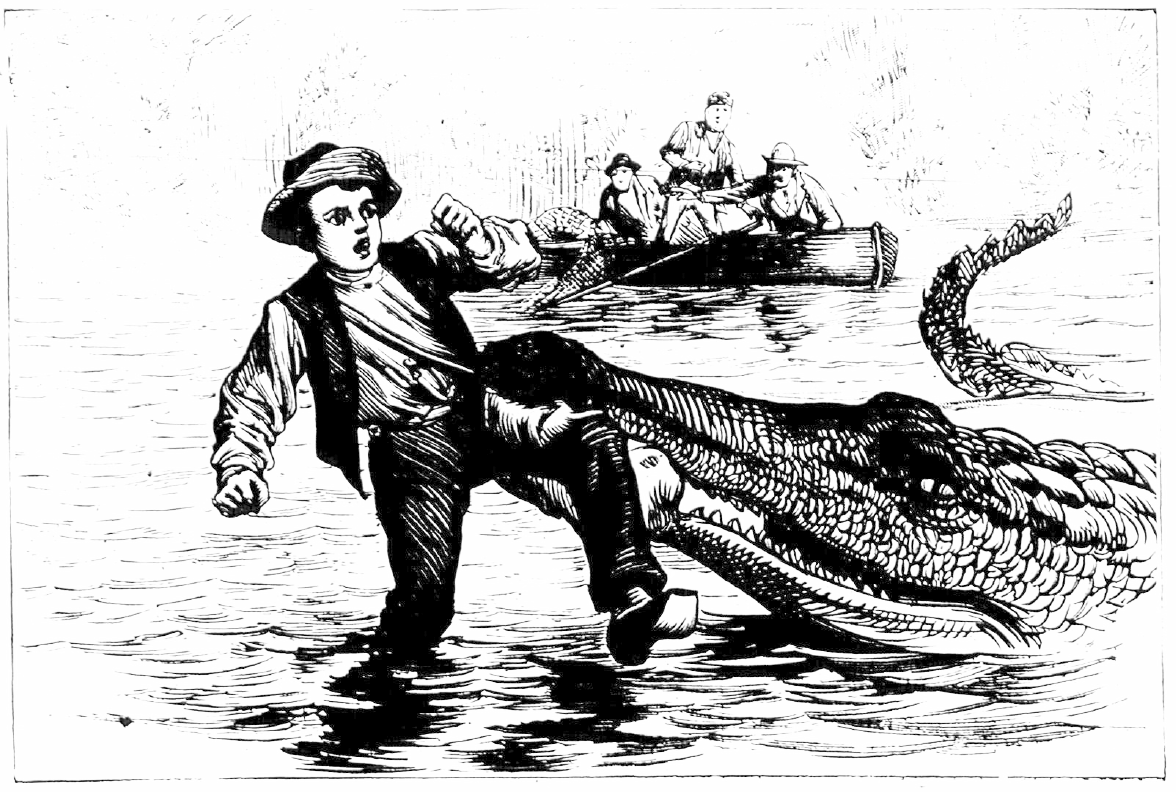
How a Georgia alligator attempted to make a meal of Captain Johnson’s son. [more]
While Capt. R. B. Johnson, of Clinch county, Georgia. was helping a party of 23 or 30 men haul for trout in a millpond, the other day. his little son, Joseph. had a most thrilling experience, Master Joseph carried a bag, or corn sack, in which to deposit the fish when caught. When loaded with as many as he could carry he would take them out and make a deposit and return for more. In making one of these trips, while wading through water about three feet deep some distance from the fishermen, a monster alligator, said to be of unusual size, rose suddenly right at the boy and seized him by the thigh. A desperate struggle ensued—the boy battled for his life and the alligator for his prey. It so happened that the bag, which hung by the boy's aide, was caught In the alligator's mouth with the thigh, and It proved a sort of shield—lessening greatly the incisions made by the brute's teeth, and thus, perhaps, preventing a shock to his nervous system which might have made him succumb without the struggle which saved him his life. By an effort the boy tore his bleeding flesh from the alligator's Jaws. The monster grimly held to the sack a moment with the delusion, perhaps, that he still had his prey, affording the boy an opportunity to escape.
He had hardly extricated himself from the jaws of death before the fishermen, alarmed by the struggle, were at hand, and another battle ensued. Thirty men, armed with gigs, poles, pocket knives and such other instruments of war as were at hand, charged upon the monster. Being In three feet of water, the 'gator bad considerable advantage, but those men had their blood up and were not to be outdone. They poled and punched and harpooned him until the brute was almost outdone, when one of the party made bold to seize him by the tail. This was a signal for a general assault. In less time than it would take to tell it, a number of the more daring had him by the tail and legs. There were too many of them for the 'gator to slap around with his tall, a peculiar mode of n 'gator warfare, and he had to give up the fight. A harpoon was plunged into his mouth and then it was safe to approach him with pocket knives. Soon his head was severed from his body, and the victorious party marched out of the pond with the monster's head on a pole.
Reprinted from National Police Gazette, December 15, 1883.
Welcome to the National Night Stick
"We follow vice and folly where a police officer dare not show his head, as the small, but intrepid weasel pursues vermin in paths which the licensed cat or dog cannot enter."The Sunday Flash 1841

- 1810s
- 1820s
- 1830s
- 1840s
- 1850s
- 1860s
- 1870s
- 1880
- 1880s
- 1890
- 1890s
- Abduction
- Abortion
- Accident
- Actors
- Adultery
- Advertisement
- African Americans
- Alabama
- Alcohol
- Allan Pinkerton
- America
- Animal
- Assault
- Axe Murder
- Bank Robbery
- Barnum
- Baseball
- Beer
- Bet
- Bicycle
- Billiards
- Bio
- Boston
- Boxing
- Boys
- Broadway
- Brooklyn
- Brothel
- Buffalo
- Burglar
- Burglary
- Burlesque
- California
- Canada
- Cartoon
- Censorship
- Chicago
- children
- Chorus Girls
- Christmas
- Cincinnati
- Civil War
- Clergy
- Clubbing
- College
- Colorado
- Comstock
- Con Game
- Connecticut
- Counterfeit
- Court
- Cowboy
- Crime
- cross-dressing
- Crossdressing
- Cursing
- Dancing
- Deception
- Delinquents
- Denver
- Detectives
- Detroit
- Dime Novels
- Disaster
- Disguise
- Disorderly conduct
- Divorce
- Domestic Violence
- Drowning
- Duel
- Editorial
- Election
- Entertainment
- Event
- Fad
- Family
- Fashion
- Fight
- Fire
- Florida
- Food
- Football
- Forger
- Fraud
- Gambling
- Gangs
- Georgia
- Great Detectives
- Gunshot
- Hoax
- Holiday
- Horses
- Hotel
- Illinois
- Indiana
- Insanity
- Jail Break
- Jealousy
- Justice
- Kansas
- Kentucky
- Little Murders
- Louisiana
- Lynching
- Maine
- Marriage
- Maryland
- Massachusetts
- Medicine
- Michigan
- Minnesota
- Missouri
- Montana
- Murder
- Music
- Nevada
- New Hampshire
- New Jersey
- New Orleans
- New Year
- New York
- New York City
- Newsboys
- Newspaper
- Nudity
- Obscenity
- Ohio
- Opium
- Pennsylvania
- Performer
- Petrified man
- Photography
- Pickpocket
- Poisoning
- Police
- Police Gazette
- Politics
- Prank
- Prison
- Prostitution
- Railroad
- Rape
- Rats
- Reform
- Religion
- Reporters
- Revenge
- Rhode Island
- Robbery
- Romance
- Saloon
- San Francisco
- Scandal
- Science
- Seasonal
- Sex
- Slashing
- Society
- Spiritualism
- Sport
- Sports
- Spousal Abuse
- St. Louis
- Stabbing
- Steamboat
- Steamship
- Stock Broker
- Suicide
- Summer
- Tammany Hall
- Temperance
- Tennessee
- Texas
- Theatre
- Theft
- Thomas Byrnes
- Valentine
- Vigilantes
- Voyeur
- War
- Washington D.C.
- Wife beaters
- Winter
- Women