

Society Women Turn Burglars.



Tag: Stabbing
A Duel on Horseback.
Two rivals for the affections for an Arkansas belle fight a desperate battle with knives and are horribly mangled, near Bear Creek.

Gambler Vs. Cook.
James Toohey, a Covington, Neb., scullion, gets awfully mad and fatally stabs a man about town named Erwin.
A Bloody Ruction.
Bayonets and Knives—A Sister’s Influence and Prevention of Murder.
He May Be Lynched.
Miss Lily Dunkley, a Miles City, Mont., girl, refuses to marry Charles Snyder and he tries to kill her.
He May Be Lynched.
Miss Lily Dunkley, a Miles City, Mont., girl, refuses to marry Charles Snyder and he tries to kill her.
Stabbed for not Buying Drinks.
Fresh Young Fellow Gets Six Inches of Cold Steel at a Sporting Resort, Seattle, Wash.
Strange Company - 10/23/2026
Early American Crime - 2/7/2019


Soapy Smith's Soap Box - 10/13/2025

Murder By Gaslight - 10/24/2026

Executed Today - 11/13/2020

Surf Swimming at Hawaii, Sandwich Islands. | Amateur Photography.
Society Women Turn Burglars.
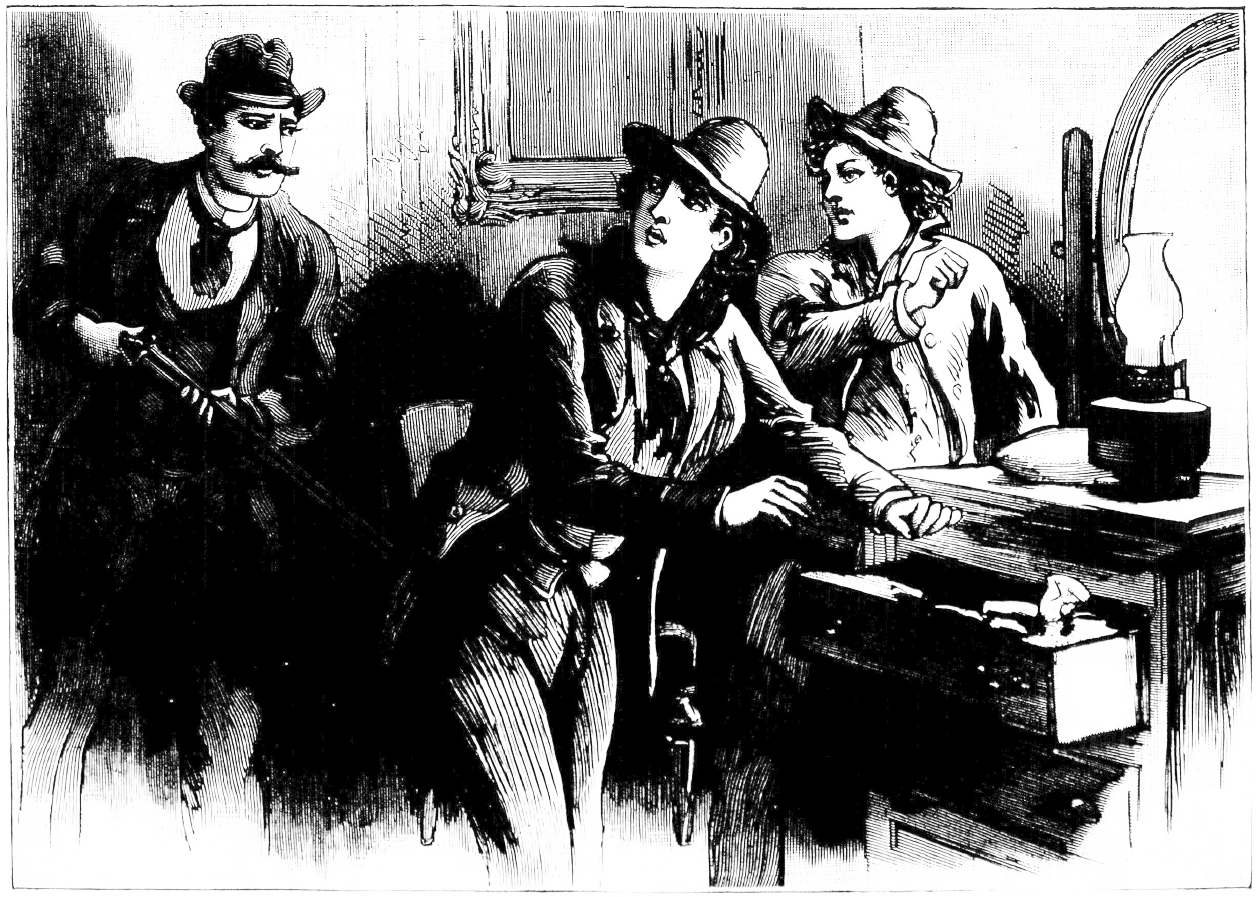
A Widow and Her Pretty Daughter Caught Thieving in Men’s Attire in Tecumseh, Mich. [more]
Mrs. Alice Church, a comely widow, thirty-eight years of age, and Bessie Church her daughter, eighteen years of age, were arrested recently in Tecumseh, Mich. In the act of committing a burglary. They were dressed in men’s clothes.
The two women moved in the best society, were members of the church, active in charitable work and eminently respectable as to conduct. The women confess their guilt, stat that they have committed a score of burglaries and will gladly accept any punishment that is meted out to them. It was at first believe that they were insane, but that theory has been abandoned.
Mrs. Church and her daughter have live in Tecumseh several years. Both dressed well and the girl is not only unusually bright, but quite handsome. They numbered among their friends nearly all the best people in Tecumseh. They lived modestly and stated that their income came from the life insurance of the late Mr. Church. Mrs. Church was popular with the beaux of the town, but it was observed that she froze them with dignity when they became too demonstrative.
Early in the summer the home of a prominent family was entered one evening and some jewelry and wearing apparel were taken. No trace of the burglars could be discovered. About the time the incident was dropping out of the public mind another house was entered. Some money and jewelry was taken from this house, and, as before, the family were absent the evening of the occurrence. The station was watched and all the roads out of town guarded, but now burglars were arrested. The town police were puzzled.
The burglaries followed each other in quick succession during July and August. The whole town was excited. Strangers were eyed with suspicion and citizens lay in ambush night after night without accomplishing anything.
All the houses were entree in the same manner through the back door or a window opening on a porch. Occasionally groceries and food were taken. This led to the belief that the burglars were tramps. There was a secession of night work during September but early this month the burglaries resumed. The houses were entered usually during the absence of a family, but in many instances houses were robbed in which several men were sleeping.
Last week the home of the late Judge Stacey, occupied by Mrs. Stacy and her daughter, was broken into and robbed of goods valued at $500. A reward was offered and a score of amateur detectives set to work and beyond arresting a few trams who were clearly innocent nothing came of it.
Relatives then decided to take turns watching the house. About 1 o’clock the other morning one of the watchers observed what he supposed were two men approaching the house. He got a shotgun and waited. The burglars lifted a window and boldly entered. The man with the shotgun decided to wait until they entered the dining-room, when he could get a better light on the targets. The tow figures entered the dining-room, and as the watcher aimed the gun the light fell on the face of Widow Church. He could barely believe his eyes. It was Mrs. Church and her daughter dressed up in men’s clothes.
He lowered the gun, approached and arrested both. They screamed, but recovered their composure, and in the presence of Mrs. Stacy confess to all the burglaries.
The women had a preliminary examination, at which the whole town was present. They were held for trial. It is said that they stole to keep form starving, and that a false pride prevented them from telling their friends of their condition.
Reprinted from National Police Gazette, November 4, 1893.
Welcome to the National Night Stick
"We follow vice and folly where a police officer dare not show his head, as the small, but intrepid weasel pursues vermin in paths which the licensed cat or dog cannot enter."The Sunday Flash 1841




- 1810s
- 1820s
- 1830s
- 1840s
- 1850s
- 1860s
- 1870s
- 1880
- 1880s
- 1890
- 1890s
- Abduction
- Abortion
- Accident
- Actors
- Adultery
- Advertisement
- African Americans
- Alabama
- Alcohol
- Allan Pinkerton
- America
- Animal
- Assault
- Axe Murder
- Bank Robbery
- Barnum
- Baseball
- Beer
- Bet
- Bicycle
- Billiards
- Bio
- Boston
- Boxing
- Boys
- Broadway
- Brooklyn
- Brothel
- Buffalo
- Burglar
- Burglary
- Burlesque
- California
- Canada
- Cartoon
- Censorship
- Chicago
- children
- Chorus Girls
- Christmas
- Cincinnati
- Civil War
- Clergy
- Clubbing
- College
- Colorado
- Comstock
- Con Game
- Connecticut
- Counterfeit
- Court
- Cowboy
- Crime
- cross-dressing
- Crossdressing
- Cursing
- Dancing
- Deception
- Delinquents
- Denver
- Detectives
- Detroit
- Dime Novels
- Disaster
- Disguise
- Disorderly conduct
- Divorce
- Domestic Violence
- Drowning
- Duel
- Editorial
- Election
- Entertainment
- Event
- Fad
- Family
- Fashion
- Fight
- Fire
- Florida
- Food
- Football
- Forger
- Fraud
- Gambling
- Gangs
- Georgia
- Great Detectives
- Gunshot
- Hoax
- Holiday
- Horses
- Hotel
- Illinois
- Indiana
- Insanity
- Jail Break
- Jealousy
- Justice
- Kansas
- Kentucky
- Little Murders
- Louisiana
- Lynching
- Maine
- Marriage
- Maryland
- Massachusetts
- Medicine
- Michigan
- Minnesota
- Missouri
- Montana
- Murder
- Music
- Nevada
- New Hampshire
- New Jersey
- New Orleans
- New Year
- New York
- New York City
- Newsboys
- Newspaper
- Nudity
- Obscenity
- Ohio
- Opium
- Pennsylvania
- Performer
- Petrified man
- Photography
- Pickpocket
- Poisoning
- Police
- Police Gazette
- Politics
- Prank
- Prison
- Prostitution
- Railroad
- Rape
- Rats
- Reform
- Religion
- Reporters
- Revenge
- Rhode Island
- Robbery
- Romance
- Saloon
- San Francisco
- Scandal
- Science
- Seasonal
- Sex
- Slashing
- Society
- Spiritualism
- Sport
- Sports
- Spousal Abuse
- St. Louis
- Stabbing
- Steamboat
- Steamship
- Stock Broker
- Suicide
- Summer
- Tammany Hall
- Temperance
- Tennessee
- Texas
- Theatre
- Theft
- Thomas Byrnes
- Valentine
- Vigilantes
- Voyeur
- War
- Washington D.C.
- Wife beaters
- Winter
- Women