No. 120
Crime, Eccentricity, and the Sporting Life in 19th Century America.
December 04, 2012

The Diamond King.

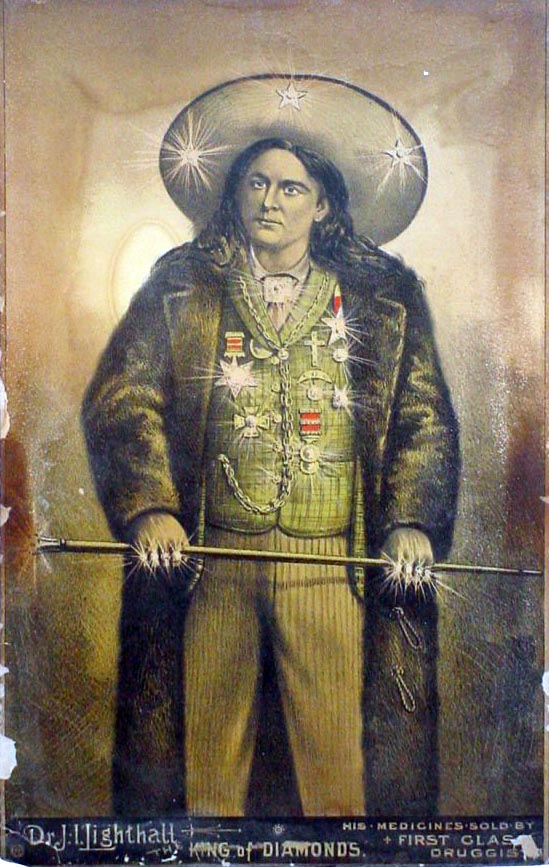
J. I. Lighthall, better known as the Diamond King, was a charismatic showman and a master of marketing, but he was also a dedicated healer.
December 4, 2012

...
...

There are certain people who, for one reason or another, have a way of attracting people who are eager to murder them.  What makes the following case stand out is that exactly the opposite appears to have happened: A man was desperate to find someone willing to kill him, and he had a damned hard time achieving that goal.Samuel Resnick was a jeweler in Albany, New York, for nearly thirty
More...
Strange Company - 3/16/2026
"As his son I am proud of hisefforts to succeed in life"Jefferson Randolph Smith IIIArtifact #93-2Jeff Smith collection(Click image to enlarge) oapy's son hires a legal firm to stop the defamation of his father's name. At age 30, Jefferson Randolph Smith III, Soapy and Mary's oldest son, was protecting his father's legacy and his mother's reputation from "libel" and scandal. He was also
More...
Soapy Smith's Soap Box - 10/13/2025
Bond Street today is a pricey place to live. And so it was in the 1830s, when it became one of New York’s most exclusive enclaves. Wealthy residents fleeing the crowded and increasingly commercial neighborhoods below Houston Street sought refuge on this short little street, which only runs two blocks from Broadway to the Bowery. […]
More...
Ephemeral New York - 3/16/2026
Youth With Executioner by Nuremberg native Albrecht Dürer … although it’s dated to 1493, which was during a period of several years when Dürer worked abroad. November 13 [1617]. Burnt alive here a miller of Manberna, who however was lately … Continue reading
More...
Executed Today - 11/13/2020
About half past three, the morning of July 2, 1863, a young man on his way to work in Medina, Ohio, saw the home of Shubal Coy in flames. He alerted the neighbors, who came out to douse the flames with water. When the fire was under control, they went inside to look for the Coy family. They found Shubal lying in bed with nine stab wounds in his throat and breast, any one of them capable of
More...
Murder By Gaslight - 3/14/2026
The good-looking thirty-seven year old gentleman handling the reins behind the glossy matched pair pulling the spanking-new carriage drew the attention of more than one feminine eye.  Pacing down French St. at a sharp clip, the lady next to him, dressed neatly in a tailor-made suit with the latest in millinery fashion, smiled up at her coachman. Behind the lace curtains on the Hill section of Fall River, tongues were wagging about the unseemly pair. Lizzie Borden, acquitted of double homici
More...
Lizzie Borden: Warps and Wefts - 10/16/2025
  [Editor’s note: Guest writer, Peter Dickson, lives in West Sussex, England and has been working with microfilm copies of The Duncan Campbell Papers from the State Library of NSW, Sydney, Australia. The following are some of his analyses of what he has discovered from reading these papers. Dickson has contributed many transcriptions to the Jamaica […]
More...
Early American Crime - 2/7/2019
Taking a Criminal's Measure. | The Grand Saloon.

The Diamond King.

Diamond Kng

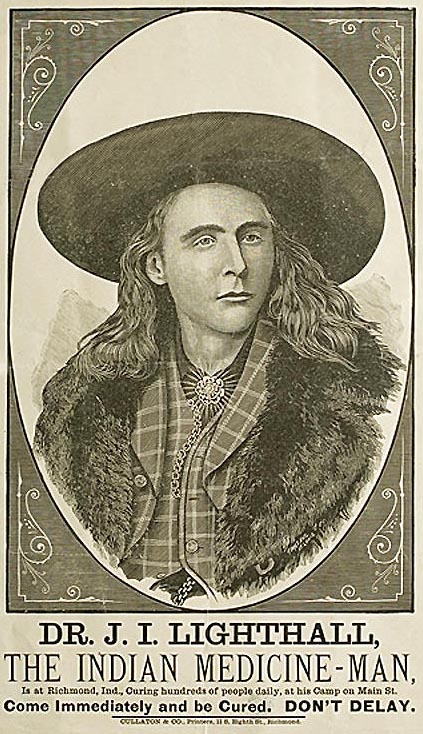
By the end of the nineteenth century, hundreds of self-proclaimed doctors crisscrossed America in traveling medicine shows. Some led elaborate tent shows with dozens of performers using patent medicine sales to finance their productions. Other focused more on the medicine than the show.  J. I. Lighthall, better known as the Diamond King, was a bit of both—he was a charismatic showman and a master of marketing, but he was also a dedicated healer.

Lighthall

J. I. Lighthall was born in Tiskilwa, Illinois in 1856. He claimed to be one-eighth Indian and left home at age eleven bound for the Indian Territory where he learned “Indian Herbal Theory.” Lighthall decided that “what was good for an Indian certainly was good for a white man” and he considered it his duty to share his knowledge with the civilized world.

A natural born showman, J. l. Lighthall soon had one of the most impressive medicine shows in the country. At its height, Lighthall’s show would enter a town with a fabulous procession of cowboys and Indians, singers and other performers, a brass band, wagons pulled by decorated horses, and a brass-trimmed chariot.

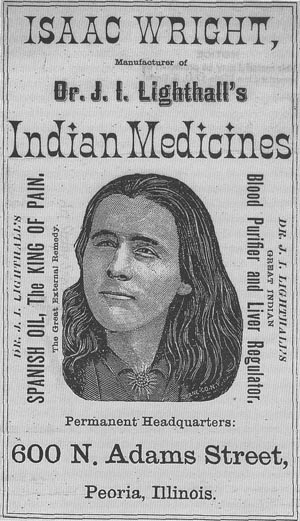
Lighthall was boyishly handsome with long flowing hair. He was known as the Diamond King for the flamboyant diamond studded costumes he wore. Sometimes he would appear in an ankle-length sealskin coat with matching broad-brimmed hat; sometimes in a red velvet suit with buttons made from $5, $10 and $20 gold pieces and a Mexican sombrero trimmed in gold and silver.

As many traveling doctors did, Lighthall advertised painless dentistry, and he would open each show by pulling teeth, free of charge. As the brass band played, Lighthall, with incredible speed, went to work, tossing each extracted tooth high in the air. He claimed his home in Peoria had a walk paved with human teeth.

King-of-pain

The Diamond King’s signature product was called Spanish Oil, The King of Pain, a blood purifier and liver regulator. The tonic, a brown liquid which reportedly smelled like a combination of turpentine and whiskey was made in Peoria by Lighthall’s mother and her third husband Isaac Wright and shipped to the Diamond King’s camp and to drugstores throughout the country. This is how Lighthall described it in verse:

A balm is hidden in the leaf,
That God has given for relief.
The Indians of the Western plains
Have found that they will cure our pains

So now the author does extend
A helping hand, an honest friend.
He’ll cure your aches, relieve your pain
If you will buy his King of Pain.

It’s made of barks, and oils and leaves,
And seldom ever man deceives.
It never fails to satisfy
And on it, friends, you can rely

In 1882, J. I. Lighthall published a book entitled The Indian Household Medicine Guide. In addition to being a comprehensive guide to Lighthall’s brand of herbal healing - including dozens of recipes - the book is a good layman's guide to conventional nineteenth-century medical knowledge. For those with health problems, the book included a list of health-related questions which could be answered and sent to Lighthall’s office. He would send his diagnosis and prescription by return mail.

In January 1886, J. I. Lighthall, twenty-nine years old, died of smallpox while performing in San Antonio, Texas. His passing was noted by newspapers throughout America.


Sources:

  • Fowler, Gene. Mystic healers & medicine shows: blazing trails to wellness in the Old West and beyond. Santa Fe, N.M.: Ancient City Press, 1997.
  • Lighthall, J. I.. The Indian household medicine guide. Peoria, Ill.: [s.n.], 1882.
  • McNamara, Brooks. Step Right Up. Jackson: University Press of Mississippi, 1995.