
No. 46
Crime, Eccentricity, and the Sporting Life in 19th Century America.
September 19, 2011

Caroline Burned!

September 19, 2011
...
...

Via Newspapers.comOne is continually reminded that Life likes to play little pranks on us.  The “Idaho Statesman,” November 12, 1947:BOSTON (UP)-Being alive on his 65th birthday Tuesday meant that Allan Sharpe of Boston had lost a $10 bet--a wager he was very pleased to have lost. Ten years ago he learned he was suffering from heart disease. The doctor told Sharpe he needed rest--a lot
More...
Strange Company - 4/29/2026
"As his son I am proud of hisefforts to succeed in life"Jefferson Randolph Smith IIIArtifact #93-2Jeff Smith collection(Click image to enlarge) oapy's son hires a legal firm to stop the defamation of his father's name. At age 30, Jefferson Randolph Smith III, Soapy and Mary's oldest son, was protecting his father's legacy and his mother's reputation from "libel" and scandal. He was also
More...
Soapy Smith's Soap Box - 10/13/2025
There’s a curious pair of limestone row houses on the lower end of peaceful, park-facing Riverside Drive. Each looks similar from afar. They share the same color of stone, and both facades have bow fronts. But on closer look, you’ll notice that each sports different ornamental bells and whistles. One has a conical roof and […]
More...
Ephemeral New York - 4/27/2026
Youth With Executioner by Nuremberg native Albrecht Dürer … although it’s dated to 1493, which was during a period of several years when Dürer worked abroad. November 13 [1617]. Burnt alive here a miller of Manberna, who however was lately … Continue reading
More...
Executed Today - 11/13/2020
(New York Journal, August 5, 1896)Annie Bock and her husband, Jacob, were spending the summer at Rockaway Beach. On Sunday, August 1, 1896, Annie went back to their flat at 207 E. 21st Street in New York City’s Tenderloin district to pay their monthly rent. She had $300 in the Dry Dock Savings Bank, and on Monday morning, she withdrew $50 and paid $20 rent. The plan was to return to Rockaway that
More...
Murder By Gaslight - 4/25/2026
Whatever you believe about the guilt or innocence of Lizzie Borden, I have always believed film makers do a great injustice to the story by not beginning at the beginning- the death on March 26, 1863 of the first Mrs. Borden. In the dying moments of Sarah Morse, Emma takes on the weight of the care of her little sister, not yet three years old. Emma herself was just 12 on March 1st. Emma has seen her mother suffer for a long time, seen her pain and loss of little Alice Esther. Emma is old enough
More...
Lizzie Borden: Warps and Wefts - 3/26/2026
  [Editor’s note: Guest writer, Peter Dickson, lives in West Sussex, England and has been working with microfilm copies of The Duncan Campbell Papers from the State Library of NSW, Sydney, Australia. The following are some of his analyses of what he has discovered from reading these papers. Dickson has contributed many transcriptions to the Jamaica […]
More...
Early American Crime - 2/7/2019

A Map of Woman's Heart | Rum on Tap.

Caroline Burned!

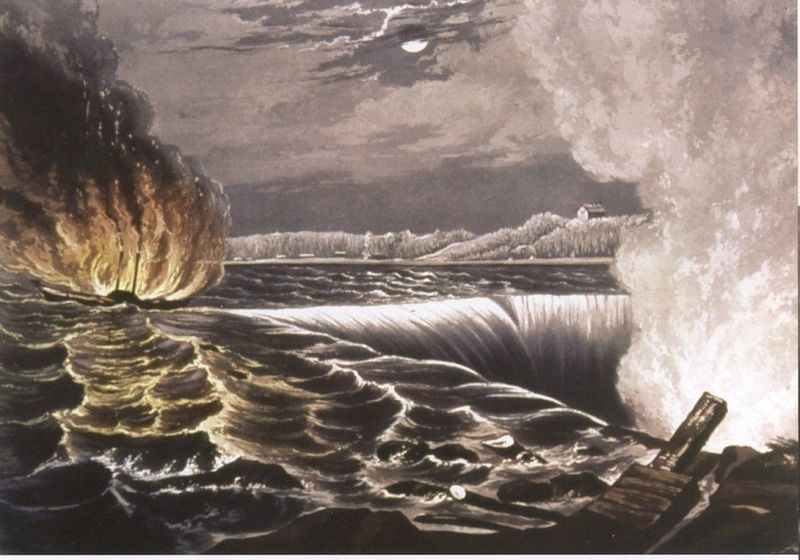
Destruction of thecCaroline Niagara River, December 19, 1837 - American steamship, Caroline, was burned by the British, and cut loose to plummet over Niagara Falls, [more]

In the years following the War of 1812, relations between the United States and Great Britain were relatively peaceful. But for many living along the border between the United States and Canada— from Vermont to Michigan—the war never really ended. On the Canadian side, rebel factions formed to liberate Canada from British rule. They were supported in the United States by private militia groups known as the Patriot Hunters. Tension continued to rise between the rebels and the British, until 1837 when the first major battle of, what would be known as the Patriot War, was fought.

In December1837, Canadian rebel leader, William Lyon Mackenzie, set up headquarters on Sailor Island, on the Canadian side of the Niagara River, and declared himself head of the provisional government of the Republic of Canada. The rebels were joined by at least 200 enthusiastic Americans. They set up artillery on the Island and began shelling the British at Fort Erie. To supply the forces with food and ammunition, the rebels employed the American owned steam ship, the Caroline.

The British Commander, Colonel Allen Napier McNabb, believed that a rebel invasion was imminent, and that the Caroline would be used in the invasion. He asked Captain Andrew Drew if he could cut out the Caroline. When Drew responded that nothing could be easier, McNabb said, “Well, go and do it.”

Drew called for volunteers who “would follow him to the devil.” He got many takers, and on the night of December 19, 1837, Drew led a group of sixty men in rowboats, across the Niagara River. Captain Drew and his men boarded the Caroline, and after a brief skirmish, during which Drew himself, killed Amos Durfee, an African American crewmember of the Caroline, the British took control of the ship. The sent the rest of the Caroline’s crew ashore, then cut it loose from the moorings. They set fires at four places on the ship, then towed it into the current, where it would be carried over Niagara Falls.

This is how the scene as described in 1839, in an American pamphlet titled, “An Address Delivered at Niagara Falls, on the evening of the twenty-ninth of December, 1838, the anniversary of the burning of the Caroline:”

“The scene now became one of awful sublimity. The Caroline was in flames, and the resistless flood was bearing on her on toward the cataract. As the fires curled about her, her engine began to work, by the heat of the burning vessel, and the pitchy flames threw a red glare on the wild scenery around her. It showed the wintry forest, and glowed upon the waters; it revealed the rebel island, and the barracks of the British soldiers. Onward the burning vessel was borne, and nearer and nearer the mighty precipice. From one side she was viewed with exultation; from the other, with deep threats of vengeance; and as she neared the foaming gulf, the hell of waters, they tell of dark forms that were seen amid the flames and of death shrieks, that rose shrill and piercing above the noise of the rushing waves. Still she rushed on, and still the scene increased in grandeur, until her burning timbers were extinguished by the flood, and a few blackened fragments, thrown up on the shore were all that remained of the ill-fated Caroline.”

Early reports said that the Caroline went over the falls with over a hundred men still aboard. In fact, the ship was empty; all except Amos Durfee had gotten off safely.

Neither the United States nor Great Britain was anxious for another confrontation so the matter was settled with discreet diplomacy. Captain Drew was tried in a New York State criminal court for the murder of Amos Durfee, but he was not convicted.

But the burning of the Caroline became a rallying cry for the people of New York State, and the ranks of the Patriot Hunters grew rapidly. Amos Durfee was the first casualty of the Patriot War; he would not be the last.

To be continued...


Sources:

Knickerbocker, or, New-York monthly magazine, Volume 13, Peabody, 1839

The Patriot War of 1837

 Raiders and Rebels