
No. 151
Crime, Eccentricity, and the Sporting Life in 19th Century America.
May 26, 2013

Undercover Lunatic.

May 26, 2013
...
...

There are certain people who, for one reason or another, have a way of attracting people who are eager to murder them.  What makes the following case stand out is that exactly the opposite appears to have happened: A man was desperate to find someone willing to kill him, and he had a damned hard time achieving that goal.Samuel Resnick was a jeweler in Albany, New York, for nearly thirty
More...
Strange Company - 3/16/2026
"As his son I am proud of hisefforts to succeed in life"Jefferson Randolph Smith IIIArtifact #93-2Jeff Smith collection(Click image to enlarge) oapy's son hires a legal firm to stop the defamation of his father's name. At age 30, Jefferson Randolph Smith III, Soapy and Mary's oldest son, was protecting his father's legacy and his mother's reputation from "libel" and scandal. He was also
More...
Soapy Smith's Soap Box - 10/13/2025
Bond Street today is a pricey place to live. And so it was in the 1830s, when it became one of New York’s most exclusive enclaves. Wealthy residents fleeing the crowded and increasingly commercial neighborhoods below Houston Street sought refuge on this short little street, which only runs two blocks from Broadway to the Bowery. […]
More...
Ephemeral New York - 3/16/2026
Youth With Executioner by Nuremberg native Albrecht Dürer … although it’s dated to 1493, which was during a period of several years when Dürer worked abroad. November 13 [1617]. Burnt alive here a miller of Manberna, who however was lately … Continue reading
More...
Executed Today - 11/13/2020
About half past three, the morning of July 2, 1863, a young man on his way to work in Medina, Ohio, saw the home of Shubal Coy in flames. He alerted the neighbors, who came out to douse the flames with water. When the fire was under control, they went inside to look for the Coy family. They found Shubal lying in bed with nine stab wounds in his throat and breast, any one of them capable of
More...
Murder By Gaslight - 3/14/2026
The good-looking thirty-seven year old gentleman handling the reins behind the glossy matched pair pulling the spanking-new carriage drew the attention of more than one feminine eye.  Pacing down French St. at a sharp clip, the lady next to him, dressed neatly in a tailor-made suit with the latest in millinery fashion, smiled up at her coachman. Behind the lace curtains on the Hill section of Fall River, tongues were wagging about the unseemly pair. Lizzie Borden, acquitted of double homici
More...
Lizzie Borden: Warps and Wefts - 10/16/2025
  [Editor’s note: Guest writer, Peter Dickson, lives in West Sussex, England and has been working with microfilm copies of The Duncan Campbell Papers from the State Library of NSW, Sydney, Australia. The following are some of his analyses of what he has discovered from reading these papers. Dickson has contributed many transcriptions to the Jamaica […]
More...
Early American Crime - 2/7/2019
Dan Creedon in Training. | What Led to a Divorce.

Undercover Lunatic.

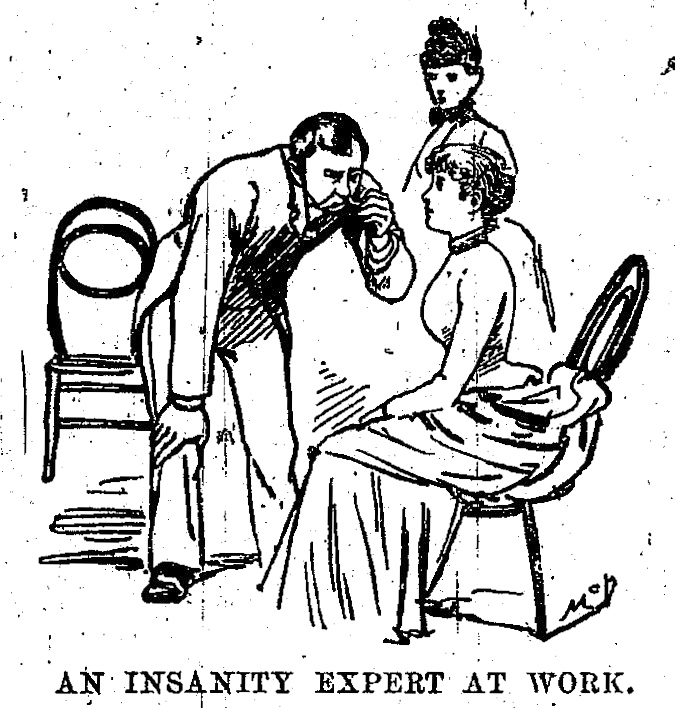
Insanity Expert

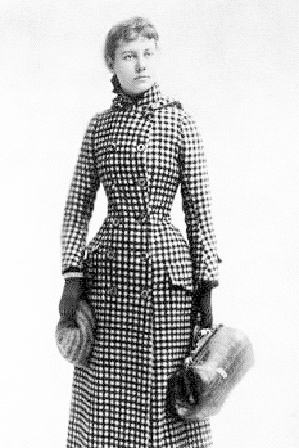
In September 1887 a young woman named Nellie Brown was declared insane and sent to the New York City lunatic asylum on Blackwell’s Island. Unbeknownst to the authorities the woman was feigning insanity; she was in fact a reporter named Nellie Bly on her first assignment for the New York World.

Nellie BlyNellie Bly

Nellie Bly had come to New York for a career in journalism. She had already made a name for herself as a reporter for the Pittsburgh Dispatch where she had worked her way up from women's stories to serious assignments such as foreign correspondent in Mexico. She was born Elizabeth Jane Cochrane but when she started writing serious pieces her editor suggested a snappier byline—“Nellie Bly,” from a popular song by Stephen Foster.

Finding work as a reporter in New York was not easy; the men there were not ready to see women in their newsrooms. After being rejected by every paper in town she finally convinced an editor at the New York World to give her a chance. She agreed to the plan of getting herself committed to Blackwell’s Island to experience conditions in the insane asylum first hand. The paper assured her that they would have her released after ten days.

Nellie Bly assumed the name Nellie Brown and checked into a temporary home for working woman where she convinced the other tenants that she was insane. A policeman took her Bellevue hospital where she was examined by a doctor. Nellie would later say that the doctors were easy to fool, she was more worried about the reporters who had taken an interest in the case. After being declared insane, Nellie was taken by boat to the asylum on Blackwell’s Island.

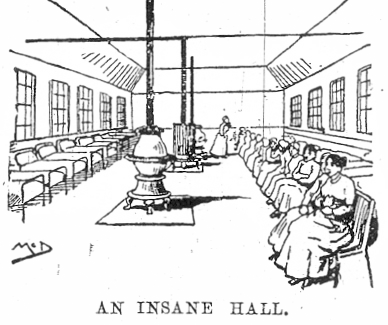
Insane Hall

Here she would meet women who were truly insane—who would shriek in the night and hold conversations with people only they could see. Just as distressing were the women whom Nellie could tell were as sane as she was, but through unfortunate circumstances found themselves in a situation they could not escape. “The insane asylum on Blackwell’s Island is a human rat-trap” she would later write, “It is easy to get in, but once there it is impossible to get out."

The conditions she experienced on Blackwell’s Island were appalling. The meals were barely edible, with rancid butter and spoiled meat. Inmates were given cold baths and made to wear garments too thin to keep out the September chill in the unheated building. There was very little entertainment beyond occasional walks outside. Most days the inmates were forced to sit quietly on wooden benches and do nothing for endless hours. Protests were met with violence by the nurses who would beat or choke unruly inmates. Even the doctors used violent methods to subdue their patients. Complaints were ignored or considered symptoms of madness.

Nellie Bly

At the end of ten days Nellie Bly was rescued by her employer. On October 7, 1887 The World published the first installment of a two part story on Nellie’s stay on Blackwell’s Island. Though bylines were rare at the time, the story included the byline “Nellie Bly.” The story was such a sensation that in the second installment, a week later, her name became part of the headline. As a result of Nellie Bly’s reporting, a grand jury was convened to investigate conditions on Blackwell’s Island and after their report an extra $1,000,000 was appropriated for the insane.

Nellie Bly’s career progressed with this type of “stunt reporting.” In 1889 she set out to best Phileas Fogg, Jules Verne’s fictional globetrotter, and travel around the world in fewer than eighty days. She did it in seventy-two. The trip made her famous and by the turn of the twentieth century “Nellie Bly” was a household name.


Sources:

  • Bly, Nellie. Ten Days in a Mad-House. New York: Ian L. Munro, 1887.
  • Kroeger, Brooke. Nellie Bly: daredevil, reporter, feminist. New York: Times Books, 1994.