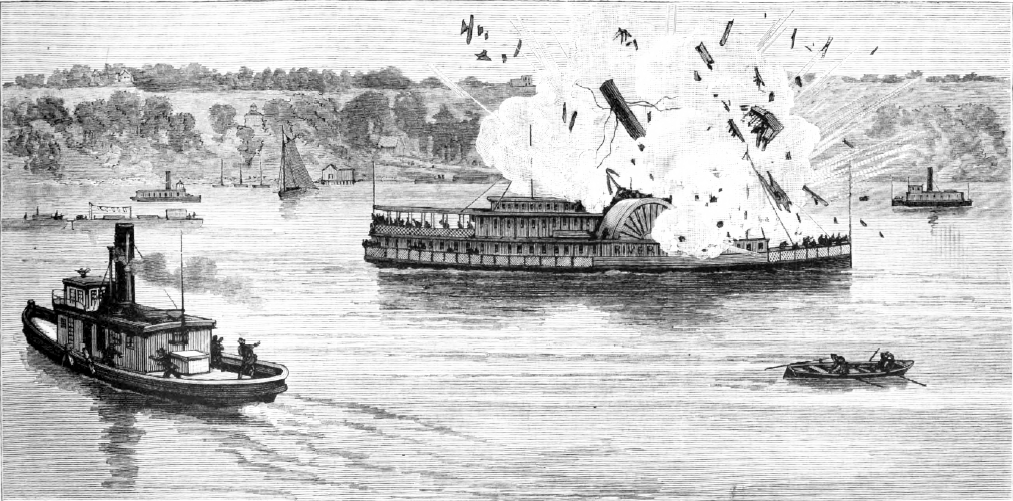

New York City, -- The Steamboat Riverdale blown up, August 28th – Rescuing the passengers.
A sad disaster occurred on the North River, off New York City, on the afternoon of August 28th, when the steamer Riverdale burst her boiler and sunk in mid-stream. The Riverdale made daily trips between this city and Haverstraw, Dobbs Ferry, Tarrytown, Yonkers, and other places up the river, and carried both freight and passengers. She had started from the Harrison Street pier, where about fifty people had boarded her, and was to take on most of her passengers at the foot of West Twenty-Second Street. As she approached that point, the pier was seen to be occupied by another vessel and the Riverdale reduced her speed. The steamer was nearly opposite the foot of Twentieth Street, and was about 150 rods from the shore, when a dull, heavy sound, like the fall of a ponderous hammer, was heard, followed by the uprising of a dense cloud of smoke, steam and flying splinters. The pilot-house and smoke-stack were thrown high in the air, and the vessel soon began to sink, disappearing from view within ten minutes. About one-half of the persons on board had distributed themselves upon the upper decks, fore and aft, while several women and children were in the after cabin. Many of them were blown into the air or thrown into the river by the shock, two being killed outright by the explosion, and a third drowned while two others died within a few hours from their injuries. Fifteen more persons were injured and the loss of life would have been much greater if a large fleet of tug-boats and row-boats which were near by had not gone immediately to the rescue. The Riverdale was an old boat, built about thirty-five years ago, and had twice changed her name. She met with an accident a year ago which would have been terribly fatal had she been laden with passengers. The drumhead of her steamchest blow off as she lay ate her dock waiting for a load of Coney Island passengers, and the steam poured forth in volumes, sweeping away the upper deck. Experienced river men say that she has been unsafe for many years, and the disaster has provoked a loud demand for a more effective inspections and government of the steamers which ply our rivers.
Reprinted from Frank Leslie's Illustrated Newspaper, September 8, 1883.
Crush, Texas, September 15, 1896-At a little after 5:00 PM, two locomotives, each travelling at a speed of 45 miles per hour, collided head-on in the town of Crush, Texas. The crash was intentional and had been anxiously anticipated by a crowd of at least 30,000 people who had been waiting all day. It was a publicity stunt by the Missouri, Kansas & Texas Railroad and had been highly successful up until the engines actually collided. In fact the Crush Collision might have become an annual event if the first one hadn’t resulted in at least one death and nine serious injuries.[more]

The plan was conceived by William George Crush, General Passenger Agent of the M. K. & T. (Katy) Railroad. The trains were pulling too many empty passenger cars and Crush was looking for a way to fill them. Having observed that train wrecks always drew large crowds, he hit on the idea of staging his own. He may also have been inspired by a train wreck staged earlier that year by the Cleveland and Hocking Valley Railroad, near Cleveland, Ohio, that drew 40,000 spectators.
Crush chose a long flat stretch of land just north of Waco. It was a natural amphitheater surrounded on three sides by mountains. He set up a makeshift town— not unlike the temporary “hell-on-wheels” towns set up during railroad construction—and named it after himself: Crush, Texas. The collision was scheduled for 4:00 PM on September 15 and advertised by posters and newspaper ads throughout Texas. A passenger could ride to Crush from anywhere on the Katy line for $2.00.
Trains started arriving at Crush at 10:00 on the 15th and every five minutes after that another train would arrive. A crowd of at least 30,000 came to watch the collision. Some estimates were as high as 50,000 people which would have made Crush the largest city in Texas for that day. A tent provided by Ringling Brothers Circus served as a restaurant and ice water was made available. Lemonade stands and carnival games were set up, and Texas politicians took the opportunity to make stump speeches. Though McLennan County was officially dry, large amounts of whiskey were consumed.

The crowd grew restless when 4:00 arrived and there was no collision. 200 hired constables held the spectators back as William Crush rode in front on a white horse threatening to cancel the show if they did not settle down. He was waiting for the arrival of several more trains. Finally at ten past five, Crush waved his hat signaling the engineers to start the show.
Two outdated diamond stack locomotives each pulling six boxcars gradually approached each other for a symbolic “handshake.” One engine painted red with green trim was numbered 999; the other green with red trim was numbered 1001. The boxcars bore advertisements for Ringling Brothers Circus and the Oriental Hotel (“The only modern hotel in Dallas.”) The trains backed up to their starting points then when the signal was given set off, full-tilt, towards each other. Each engineer forced the throttle and whistle open then jumped off the train. Torpedoes set along the track fired as each locomotive passed. Going a combined speed of 90 miles per hour, the two engines collided. They angled upward, like two stallions fighting as the train cars behind telescoped into each other. Then, counter to what Crush had been assured by his engineers, the boilers exploded.
Amid the smoke and steam, timber bolts and pieces of hot iron- from entire boiler plates to shards of shrapnel-filled the air. People in the crowd struck by the debris suffered fractured skulls and broken bones. A flying bolt took out the right eye of photographer J. C. Dean. 19-year-old Earnest Darnelle who had been watching from a tree was struck by five feet of heavy chain. He fell to earth, his head nearly severed.

The crowd stood in silence for several seconds as chaos ensued all around them. Then all at once, those still standing, rushed to the crash to grab souvenirs. At 6:00 return trains began leaving.
The M. K. & T. railroad cleaned up the mess and dismantled the town of Crush forever. They paid all claims without a fight. William George Crush was fired as General Passenger Agent, but it was all for show; he was hired back the next day.

Composer Scott Joplin may have been in the crowd that day. He wrote a song, “The Great Crush Collision March” commemorating the event.
The Dallas Morning News, September 16, 1896
The Dallas Morning News, September 17, 1896
The Dallas News, August 8, 1954
http://www.baylor.edu/lariat/news.php?action=story&story=10054