
No. 87
Crime, Eccentricity, and the Sporting Life in 19th Century America.
June 11, 2012

Street Arabs and Gutter-Snipes.

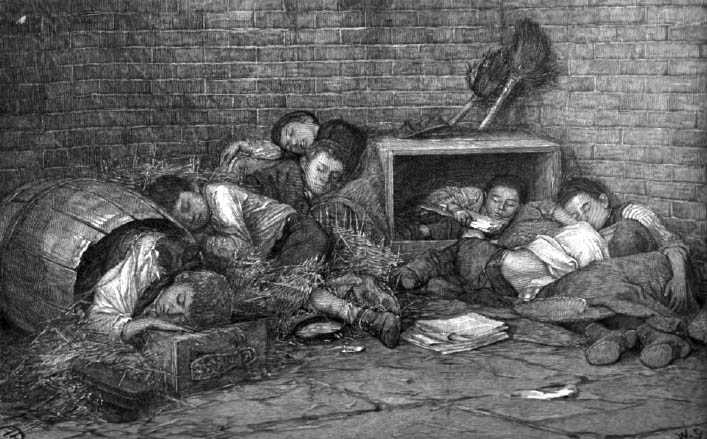
Waifs and strays of a great city - A group of homeless New York Newsboys.
June 11, 2012

...
...

Via Newspapers.comSome people could be said to create an “electric atmosphere.”This is not always a good thing.  The “Wells Journal,” December 9, 1993:A physicist claimed this week to have come up with evidence which completely exonerates pensioner Frank Pattemore for any involvement in the weird goings on with the electrical system at his home. For more than 11 years, Mr Pattemore's
More...
Strange Company - 4/1/2026
"As his son I am proud of hisefforts to succeed in life"Jefferson Randolph Smith IIIArtifact #93-2Jeff Smith collection(Click image to enlarge) oapy's son hires a legal firm to stop the defamation of his father's name. At age 30, Jefferson Randolph Smith III, Soapy and Mary's oldest son, was protecting his father's legacy and his mother's reputation from "libel" and scandal. He was also
More...
Soapy Smith's Soap Box - 10/13/2025
New York didn’t invent April Fools Day; this holiday might date back all the way to ancient Rome. But starting in the 19th century, April 1 in Gotham has been a day to celebrate with stupid pranks, outrageous hoaxes, the mocking of politicians and business leaders, and since 1986, a parade down Fifth Avenue. This […]
More...
Ephemeral New York - 3/30/2026
Youth With Executioner by Nuremberg native Albrecht Dürer … although it’s dated to 1493, which was during a period of several years when Dürer worked abroad. November 13 [1617]. Burnt alive here a miller of Manberna, who however was lately … Continue reading
More...
Executed Today - 11/13/2020
National Police Gazette, January 28, 1882Mrs. J.W. Gibbons was away from her home in Ashland, Kentucky, on December 23, 1881. She left behind her 18-year-old son Robert, her 14-year-old daughter Fannie, and 17-year-old Emma Thomas (aka Carico), who was staying with them. Mrs. Gibbons returned the following day to find her home burned to the ground and all three inhabitants dead.Read the full
More...
Murder By Gaslight - 3/28/2026
Whatever you believe about the guilt or innocence of Lizzie Borden, I have always believed film makers do a great injustice to the story by not beginning at the beginning- the death on March 26, 1863 of the first Mrs. Borden. In the dying moments of Sarah Morse, Emma takes on the weight of the care of her little sister, not yet three years old. Emma herself was just 12 on March 1st. Emma has seen her mother suffer for a long time, seen her pain and loss of little Alice Esther. Emma is old enough
More...
Lizzie Borden: Warps and Wefts - 3/26/2026
  [Editor’s note: Guest writer, Peter Dickson, lives in West Sussex, England and has been working with microfilm copies of The Duncan Campbell Papers from the State Library of NSW, Sydney, Australia. The following are some of his analyses of what he has discovered from reading these papers. Dickson has contributed many transcriptions to the Jamaica […]
More...
Early American Crime - 2/7/2019

Napoleon's Oraculum. | A Ghastly Table.

Street Arabs and Gutter-Snipes.

Their only bed A group of homeless New York Newsboys.

The rapid population expansion of New York City in the years following the Civil War was accompanied by an equally rapid expansion of in the population of homeless boys sleeping in alleys and living hand-to-mouth on the city streets. Sometimes taking to the streets to escape abusive fathers, sometimes abandoned by unwed mothers, the waifs had no family connections and no identities beyond the nicknames they gave each other. Though tough and ruggedly independent, to a great extent they survived by taking care of each other.

There were two classes of homeless boys – “street arabs” and “gutter-snipes.” Street arabs were the older, stronger boys. Sturdy and self-reliant, they were always ready to fight for what was theirs, and ready, as well, to fight for the weaker gutter-snipes who looked to them for protection. Gutter-snipes were younger boys—sometimes as young as four or five—brutalized by abusive parents and left to the dangers of the street until they find the protection of an older boy. In time the gutter-snipe would harden into a full-fledged arab with snipes of his own.

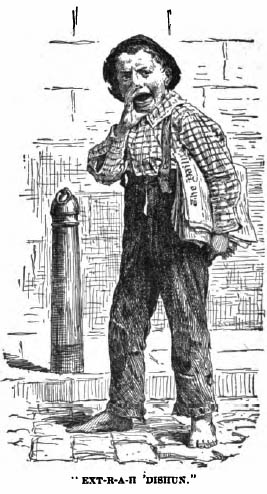
extra

The most enterprising of these boys—both street arabs and gutter-snipes—became newsboys hawking the many competitive daily newspapers sold on the streets of the city. Being a newsie required a considerable amount of self-discipline. A newsie had to wake before dawn and arrive at the newspaper with enough money in his pocket to pay for the papers he would be hawking throughout the day. During the regular course of business, they respected each other’s turf and would not interfere with another boys clientele. But a fire, a brawl or any other event that drew a crowd would also draw newsboys competing directly with each other.

A number of societies and agencies were established to aid the homeless boys of New York but the boys were extremely independent and suspicious of handouts. Better to sleep outside than to risk being trapped and taken the House of Refuge. The most successful aid organization was the Newsboy’s Lodging House which offered a bed and bath for six cents a night and a hot supper for four cents. Skeptical at first, the boys came to view the Lodging House as their hotel. Rules were minimal, a gymnasium was available for their use, and reading lessons were provided for those interested.

But even with affordable lodging, many of the boys preferred sleeping outside. They were avid theatre goers and given the choice between a warm bed and a ticket to a play or vaudeville show were likely to choose the latter. Alcohol, gambling and the rest of the urban vices worked to drive the older boys from the straight and narrow.  Though the Newsboy’s Lodging House could boast of many triumphs, including homeless boys who went on to graduate from great universities, more often the lessons learned on the street prepared the boys for the fastest growing occupation in the city— crime.


Sources

  • Campbell, Helen, Thomas Wallace Knox, and Thomas Byrnes. Darkness and daylight, or, Lights and shadows of New York life: a woman's pictorial record of gospel, temperance, mission, and rescue work "in His Name" .... Hartford, Conn.: A.D. Worthington, 1897.
  • Needham, Geo. C.. Street Arabs and gutter snipes The pathetic and humorous side of young vagabond life in the great cities, with records of work for their reclamation.. Boston: D.L. Guernsey, 1884.