
No. 190
Crime, Eccentricity, and the Sporting Life in 19th Century America.
February 11, 2014

The Southern Pacific Railway Disaster.

February 11, 2014
...
...

Via Newspapers.comSome people could be said to create an “electric atmosphere.”This is not always a good thing.  The “Wells Journal,” December 9, 1993:A physicist claimed this week to have come up with evidence which completely exonerates pensioner Frank Pattemore for any involvement in the weird goings on with the electrical system at his home. For more than 11 years, Mr Pattemore's
More...
Strange Company - 4/1/2026
"As his son I am proud of hisefforts to succeed in life"Jefferson Randolph Smith IIIArtifact #93-2Jeff Smith collection(Click image to enlarge) oapy's son hires a legal firm to stop the defamation of his father's name. At age 30, Jefferson Randolph Smith III, Soapy and Mary's oldest son, was protecting his father's legacy and his mother's reputation from "libel" and scandal. He was also
More...
Soapy Smith's Soap Box - 10/13/2025
New York didn’t invent April Fools Day; this holiday might date back all the way to ancient Rome. But starting in the 19th century, April 1 in Gotham has been a day to celebrate with stupid pranks, outrageous hoaxes, the mocking of politicians and business leaders, and since 1986, a parade down Fifth Avenue. This […]
More...
Ephemeral New York - 3/30/2026
Youth With Executioner by Nuremberg native Albrecht Dürer … although it’s dated to 1493, which was during a period of several years when Dürer worked abroad. November 13 [1617]. Burnt alive here a miller of Manberna, who however was lately … Continue reading
More...
Executed Today - 11/13/2020
National Police Gazette, January 28, 1882Mrs. J.W. Gibbons was away from her home in Ashland, Kentucky, on December 23, 1881. She left behind her 18-year-old son Robert, her 14-year-old daughter Fannie, and 17-year-old Emma Thomas (aka Carico), who was staying with them. Mrs. Gibbons returned the following day to find her home burned to the ground and all three inhabitants dead.Read the full
More...
Murder By Gaslight - 3/28/2026
Whatever you believe about the guilt or innocence of Lizzie Borden, I have always believed film makers do a great injustice to the story by not beginning at the beginning- the death on March 26, 1863 of the first Mrs. Borden. In the dying moments of Sarah Morse, Emma takes on the weight of the care of her little sister, not yet three years old. Emma herself was just 12 on March 1st. Emma has seen her mother suffer for a long time, seen her pain and loss of little Alice Esther. Emma is old enough
More...
Lizzie Borden: Warps and Wefts - 3/26/2026
  [Editor’s note: Guest writer, Peter Dickson, lives in West Sussex, England and has been working with microfilm copies of The Duncan Campbell Papers from the State Library of NSW, Sydney, Australia. The following are some of his analyses of what he has discovered from reading these papers. Dickson has contributed many transcriptions to the Jamaica […]
More...
Early American Crime - 2/7/2019

Nature versus Art. | Society Unveiled.

The Southern Pacific Railway Disaster.

Train

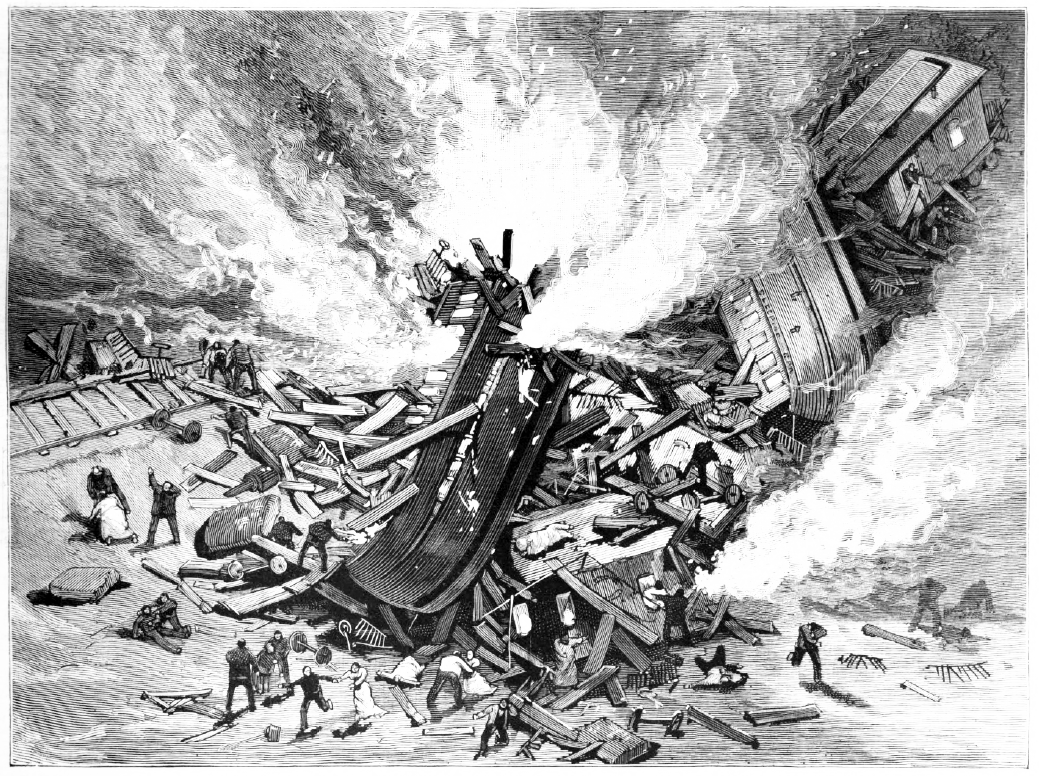
California. – The disaster on the Southern Pacific Railroad at Telegraph Pass, January 19th.

[more]One of the most terrible railroad disasters on record occurred on the Southern Pacific Railroad, near Tehachapi, Cal., about midnight on January 19th. The road at this point crosses the mountains through a pass, after having toiled up a grade of 105 feet to the mile for twenty-six miles. While the express train which had left San Francisco the day before was stopping at the station on the summit to detach an extra engine, it broke loose and started down the incline. The train gathered headway quickly, and was soon dashing down the grade at the rate of a mile a minute. At a sharp curve of the road the coach and smoker, where were ahead, broke the coupling and separated from the rest of the train, making the turn safely. The sleeping-cars and the mail, express and baggage cars were dashed against a high bank and then thrown back, rolling down an embankment. The lamps and stove at once set fire to the wreck, which was instantly in a blaze. The passengers in the sleeping-cars had retired, and had scarcely been awakened by the terrible speed with which the train dashed down the mountain before the crash came. A few escaped uninjured, or with only slight bruises, but the rest were either killed outright or burned to death in the flames. The night was intensely cold, and the point where the disaster occurred was a considerable distance from any settlement, so that little could be done for the sufferers until help arrived from Tehachapi.

In some instances a few handfuls of whitened bits of bones were all that remained of what had been a human form, and it was with great difficulty that the remains of several victims were identified. The number of dead is believed to have been thirteen, of whom the most prominent was the wife of ex-Governor Downey, of California, while several other were badly injured.

The disaster was at first attributed to carelessness of the train hands. It was said that the air-brakes had been taken off, and the men who tended the hand-brakes were away from their posts, one attending to switching the engine, and the other relighting his extinguished lamp. The railroad officials, however, declare that the accident was the result of an attempt to rob the express car. They claim that the hand-brakes were properly set by the brakemen, but that, while one of the was escorting a lady to the station, some miscreants let off the brakes and started the train down the grade in order to get it away from help and in a position where the express car could be robbed. Being inexperienced, they lost control of the train, and the disaster occurred. Some support is lent to this theory by the fact that when the train drew into the station two men were seen there who were subsequently found dead in the wreck, and who are as yet unidentified. 


Reprinted from "The Southern Pacific Railway Disaster." Frank Leslie's Illustrated Newspaper 3 Feb 1883.