
Welcome to the latest Link Dump!This week, we are honored to be visited by some genuine royalty.That time someone stole 80,000 pounds of butter.The complicated medieval legal term, "raptus."The Roman Woman of Spitalfields.How medieval Europeans ate before contact with the Americas.You never know what you'll find in medieval latrines. Other than the obvious, of course.You never know
Maggie Crowley.(New York Journal, March 16, 1898.)On March 15, 1898, a woman was found strangled to death in the courtyard of a New York City tenement. She was the seventh strangulation victim in the Tenderloin district over the previous four years. What made this case different was that even before the victim was identified, the police had a suspect in custody. Some believed he was
Whatever you believe about the guilt or innocence of Lizzie Borden, I have always believed film makers do a great injustice to the story by not beginning at the beginning- the death on March 26, 1863 of the first Mrs. Borden. In the dying moments of Sarah Morse, Emma takes on the weight of the care of her little sister, not yet three years old. Emma herself was just 12 on March 1st. Emma has seen her mother suffer for a long time, seen her pain and loss of little Alice Esther. Emma is old enough
Some New York City buildings become more than buildings—they transform into symbols. Christodora House, a 16-story fortress completed in 1928 on Avenue B in the East Village, become a symbol of gentrification in the late 1980s—when a new owner converted the then-empty structure on the edge of Tomkins Square Park into condominiums. Protestors sprang into […]
"As his son I am proud of hisefforts to succeed in life"Jefferson Randolph Smith IIIArtifact #93-2Jeff Smith collection(Click image to enlarge)
oapy's son hires a legal firm to stop the defamation of his father's name.
At age 30, Jefferson Randolph Smith III, Soapy and Mary's oldest son, was protecting his father's legacy and his mother's reputation from "libel" and scandal. He was also
Some New York City buildings become more than buildings—they transform into symbols. Christodora House, a 16-story fortress completed in 1928 on Avenue B in the East Village, become a symbol of gentrification in the late 1980s—when a new owner converted the then-empty structure on the edge of Tomkins Square Park into condominiums. Protestors sprang into […]
"As his son I am proud of hisefforts to succeed in life"Jefferson Randolph Smith IIIArtifact #93-2Jeff Smith collection(Click image to enlarge)
oapy's son hires a legal firm to stop the defamation of his father's name.
At age 30, Jefferson Randolph Smith III, Soapy and Mary's oldest son, was protecting his father's legacy and his mother's reputation from "libel" and scandal. He was also
Welcome to the latest Link Dump!This week, we are honored to be visited by some genuine royalty.That time someone stole 80,000 pounds of butter.The complicated medieval legal term, "raptus."The Roman Woman of Spitalfields.How medieval Europeans ate before contact with the Americas.You never know what you'll find in medieval latrines. Other than the obvious, of course.You never know
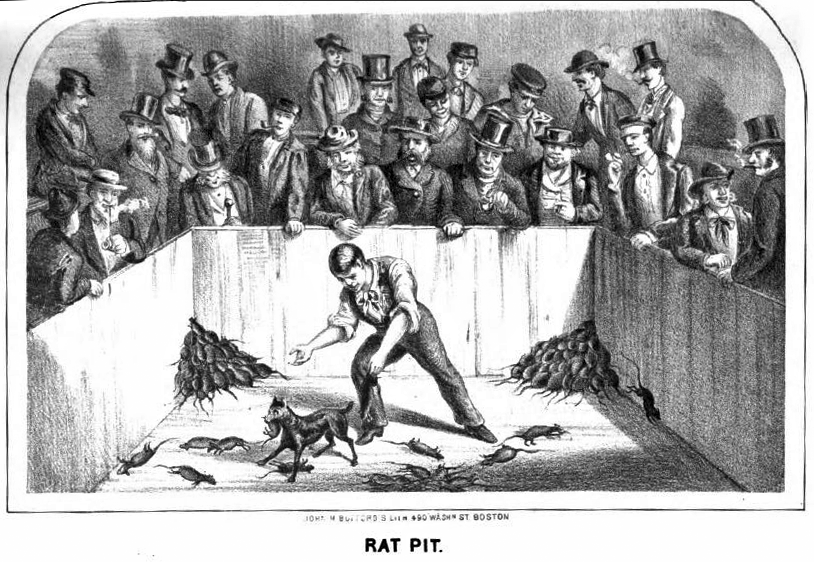
A rat pit is one of those under-ground novelties occasionally seen in Boston by gaslight.
From Police records and recollections, or, Boston by daylight and gaslight for two hundred and forty years, by Edward Savage, 1873:
The pit consists of a board crib of octagon form in the center of the cellar, about eight feet in diameter ad three and one half feet high, tightly secured at the sides. On three sides of the cellar are rows of board seats, rising one above the other, for the accommodation of spectators. On the other side, stands the proprietor and his assistant and an empty flour barrel, only it is half full of live rats, which are kept in their prison-house by a wire netting over the top of the cask. The amphitheatre is lighted with oil lamps or candles, with a potato, a turnip, or an empty bottle for a candlestick. Spectators are admitted at twenty-five cents a head, and take their seats, when preparations for the evening’s entertainment commence. The proprietor carefully lifts the edge of the wire netting over the rat barrel, and with an instrument looking much like a pair of curling tongs, he begins fishing out his game, rat by rat, depositing each carefully inside the pit until the requisite number are pitted. The assistant has brought in the dog, Flora, a favorite ratter, which he is obliged to hold fast by the nape of the neck, so eager is she for the fray. Then commences the betting, which runs high or low according t the amount of funds in the hands of the sports
“A dollar. She kills twenty rats in twelve seconds!” “I take that!” “Half a dollar on the rats!” “Don’t put in them small rats!” “Two dollars on Flora in fifteen seconds!” “Done at fourteen!” “No you don’t!” “Don’t put in all your big rats at once!” “Five dollars on the rats in ten seconds!” (no takers.)
The betting all seems to be well understood, but it would puzzle an outsider to tell whether there were really any genuine bets or not.
The bets having been arranged, time is called, and Flora is dropped into the ring. Flora evidently understands that her credit is at stake; but the growling and champing, and squealing, and scratching is soon over, and the twenty rats lie lifeless at the feet of the bloodthirsty Flora, when time is again called, and the bets decided, and all hands go up and liquor. This exhibition is repeated several times, with different dogs, and lasts as long as the live rats hold out.
Source:
Savage, Edward. Police records and recollections, or, Boston by daylight and gaslight for two hundred and forty years. Boston: J.P. Dale, 1873.
"We follow vice and folly where a police officer dare not show his head, as the small, but intrepid weasel pursues vermin in paths which the licensed cat or dog cannot enter."
The Sunday Flash 1841