
The Diamond King.



Strange Company - 9/21/2026
Early American Crime - 2/7/2019

Soapy Smith's Soap Box - 10/13/2025
Murder By Gaslight - 9/19/2026
Executed Today - 11/13/2020

Taking a Criminal's Measure. | The Grand Saloon.
The Diamond King.
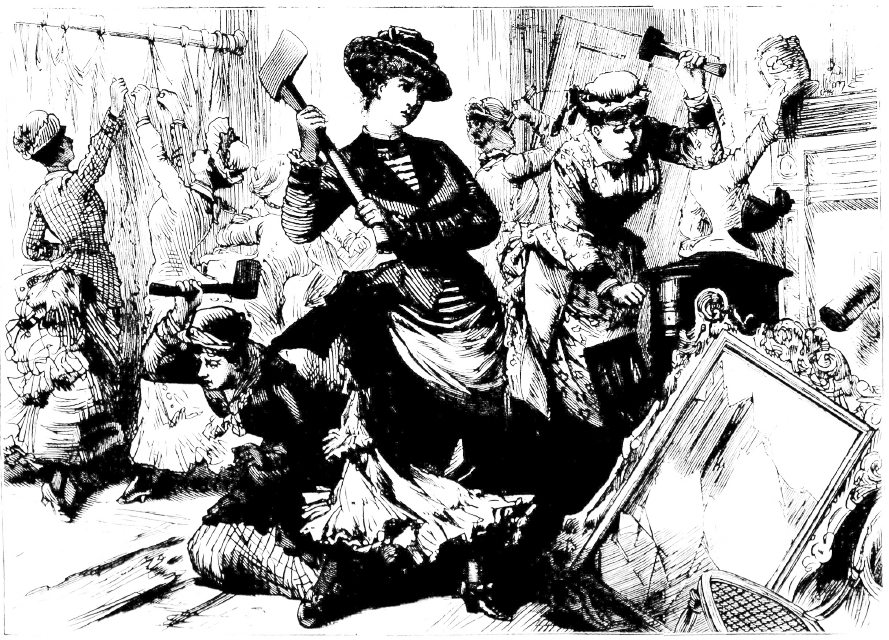
The White Hat of Lafayette, Ind., is burst up by a mob of women. [more]
A little before dark on the evening of Sept. 9, a crowd of indignant women, numbering about forty; reduced the bagnio of the notorious “White Hat,” on Sixteenth street, Lafayette, Ind., to a complete if not picturesque ruin. It was a quiet but determined vigilante committee, and they did their work well. White Hat’s dive has long gloried in the reputation of the hardest place in Lafayette. It was a free for all. Race, color or previous condition of servitude was no bar. It was a cross between an old woman’s home and a pest house, and a stench to the nostrils of the neighborhood. The place has long been under police surveillance, and on the night mentioned above it was raided. The male guests scaled the back fence and fled, but four women, including White Hat, were run in. Next morning they were given thirty days apiece in jail. This episode left the establishment, for the time being, tenantless.
At a little after 4 o’clock the women of the neighborhood began to congregate on an adjacent corner. The news that the ranch was to be demolished spread like wildfire, and the crowd soon numbered two score. When it reached these dimensions the onslaught was made. A few determined women led the van and the rest streamed after, over the front yard. The house is a double brick, and the dive proper was in the south side. Here attentions were directed.
One of the women had an axe. She was about forty-five years old, tall, strong, and when she brought the blade against the panels they went in with a crash. A few more blows sent the door of its hinges. Almost a dozen of the boldest rushed in and began to demolish the interior, while the timorous contented themselves in throwing stones on the outside.
For a few moments it sounded like a fusillade of artillery, and in that length of time there wasn’t a piece of glass the size of a half dollar in any window in the establishment. Meanwhile several other axes had been brought into play and all the window frames and door cases splintered. Even the floor did not escape and was badly backed, while big chunks of plastering were knocked bodily out of the ceiling.
In the course of the afternoon most of the effects of the White Hat outfit had been removed on a dray, so there were but few household goods for the crowd to wreak their vengeance on. A cooking stove was the most conspicuous object, and this was speedily reduced to junk iron. Their work of ruin occupied in all about half an hour and the crowd then quietly departed. They did not stop to talk the matter over, but went straight home, and the demoralized house was the sole evidence of what had occurred. The work was viewed by a large crowd of men but none offed to interfere. They knew better.
The end of the trouble was not, however, in the event described above. At 9:10 in the evening an alarm of fire came in and called the department to the vicinity. Flames were seen braking through the roof of the dismantled edifice and rapidly spreading along the woodwork. The fire was obviously the work in an incendiary, as there had been no fire about the premises during the day. A little brisk work soon extinguished the blaze with a big hole burst through the shingles and considerable damage to the interior. It will take quite an outlay of money to put the property in anything like a condition to rent again. The fire is generally accepted as a final notification to the outfit that their presence will be no longer tolerated in Linnwood. It was said on the ground that the parties who fired the house are well known and will use dynamite the next trip if it is occupied again by the same kind of cattle.
Reprinted from The National Police Gazette, September 26, 1885.
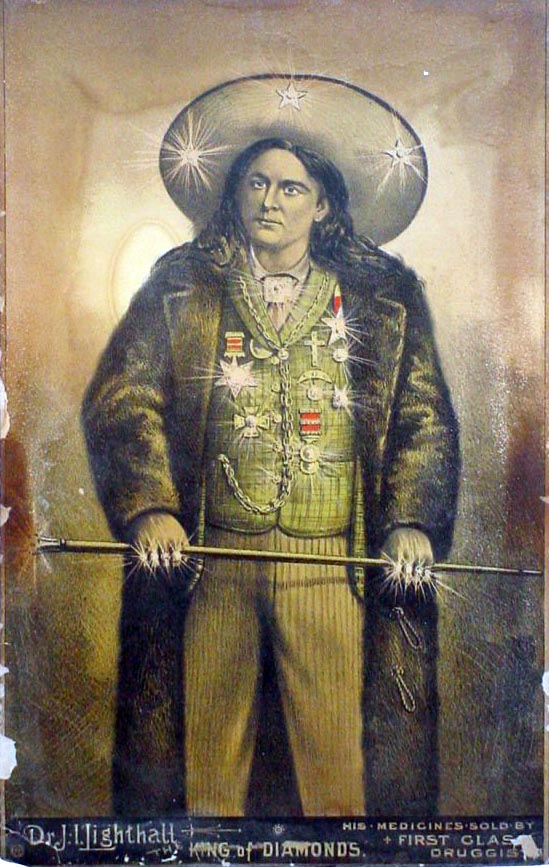
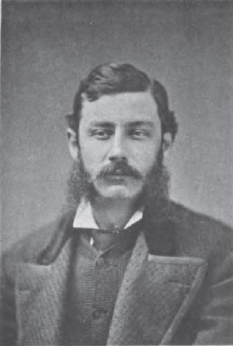
By the end of the nineteenth century, hundreds of self-proclaimed doctors crisscrossed America in traveling medicine shows. Some led elaborate tent shows with dozens of performers using patent medicine sales to finance their productions. Other focused more on the medicine than the show. J. I. Lighthall, better known as the Diamond King, was a bit of both—he was a charismatic showman and a master of marketing, but he was also a dedicated healer.
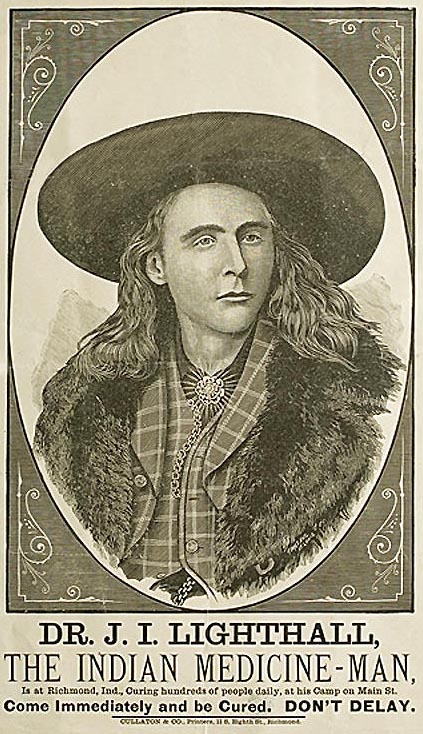
J. I. Lighthall was born in Tiskilwa, Illinois in 1856. He claimed to be one-eighth Indian and left home at age eleven bound for the Indian Territory where he learned “Indian Herbal Theory.” Lighthall decided that “what was good for an Indian certainly was good for a white man” and he considered it his duty to share his knowledge with the civilized world.
A natural born showman, J. l. Lighthall soon had one of the most impressive medicine shows in the country. At its height, Lighthall’s show would enter a town with a fabulous procession of cowboys and Indians, singers and other performers, a brass band, wagons pulled by decorated horses, and a brass-trimmed chariot.
Lighthall was boyishly handsome with long flowing hair. He was known as the Diamond King for the flamboyant diamond studded costumes he wore. Sometimes he would appear in an ankle-length sealskin coat with matching broad-brimmed hat; sometimes in a red velvet suit with buttons made from $5, $10 and $20 gold pieces and a Mexican sombrero trimmed in gold and silver.
As many traveling doctors did, Lighthall advertised painless dentistry, and he would open each show by pulling teeth, free of charge. As the brass band played, Lighthall, with incredible speed, went to work, tossing each extracted tooth high in the air. He claimed his home in Peoria had a walk paved with human teeth.
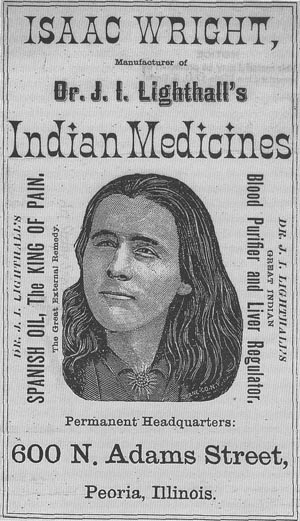
The Diamond King’s signature product was called Spanish Oil, The King of Pain, a blood purifier and liver regulator. The tonic, a brown liquid which reportedly smelled like a combination of turpentine and whiskey was made in Peoria by Lighthall’s mother and her third husband Isaac Wright and shipped to the Diamond King’s camp and to drugstores throughout the country. This is how Lighthall described it in verse:
A balm is hidden in the leaf,
That God has given for relief.
The Indians of the Western plains
Have found that they will cure our pains
So now the author does extend
A helping hand, an honest friend.
He’ll cure your aches, relieve your pain
If you will buy his King of Pain.
It’s made of barks, and oils and leaves,
And seldom ever man deceives.
It never fails to satisfy
And on it, friends, you can rely
In 1882, J. I. Lighthall published a book entitled The Indian Household Medicine Guide. In addition to being a comprehensive guide to Lighthall’s brand of herbal healing - including dozens of recipes - the book is a good layman's guide to conventional nineteenth-century medical knowledge. For those with health problems, the book included a list of health-related questions which could be answered and sent to Lighthall’s office. He would send his diagnosis and prescription by return mail.
In January 1886, J. I. Lighthall, twenty-nine years old, died of smallpox while performing in San Antonio, Texas. His passing was noted by newspapers throughout America.
Sources:
- Fowler, Gene. Mystic healers & medicine shows: blazing trails to wellness in the Old West and beyond. Santa Fe, N.M.: Ancient City Press, 1997.
- Lighthall, J. I.. The Indian household medicine guide. Peoria, Ill.: [s.n.], 1882.
- McNamara, Brooks. Step Right Up. Jackson: University Press of Mississippi, 1995.
Welcome to the National Night Stick
"We follow vice and folly where a police officer dare not show his head, as the small, but intrepid weasel pursues vermin in paths which the licensed cat or dog cannot enter."The Sunday Flash 1841


- 1810s
- 1820s
- 1830s
- 1840s
- 1850s
- 1860s
- 1870s
- 1880
- 1880s
- 1890
- 1890s
- Abduction
- Abortion
- Accident
- Actors
- Adultery
- Advertisement
- African Americans
- Alabama
- Alcohol
- Allan Pinkerton
- America
- Animal
- Assault
- Axe Murder
- Bank Robbery
- Barnum
- Baseball
- Beer
- Bet
- Bicycle
- Billiards
- Bio
- Boston
- Boxing
- Boys
- Broadway
- Brooklyn
- Brothel
- Buffalo
- Burglar
- Burglary
- Burlesque
- California
- Canada
- Cartoon
- Censorship
- Chicago
- children
- Chorus Girls
- Christmas
- Cincinnati
- Civil War
- Clergy
- Clubbing
- College
- Colorado
- Comstock
- Con Game
- Connecticut
- Counterfeit
- Court
- Cowboy
- Crime
- cross-dressing
- Crossdressing
- Cursing
- Dancing
- Deception
- Delinquents
- Denver
- Detectives
- Detroit
- Dime Novels
- Disaster
- Disguise
- Disorderly conduct
- Divorce
- Domestic Violence
- Drowning
- Duel
- Editorial
- Election
- Entertainment
- Event
- Fad
- Family
- Fashion
- Fight
- Fire
- Food
- Football
- Forger
- Fraud
- Gambling
- Gangs
- Georgia
- Great Detectives
- Gunshot
- Hoax
- Holiday
- Horses
- Hotel
- Illinois
- Indiana
- Insanity
- Jail Break
- Jealousy
- Justice
- Kansas
- Kentucky
- Little Murders
- Louisiana
- Lynching
- Maine
- Marriage
- Maryland
- Massachusetts
- Medicine
- Michigan
- Minnesota
- Missouri
- Montana
- Murder
- Music
- Nevada
- New Hampshire
- New Jersey
- New Orleans
- New Year
- New York
- New York City
- Newsboys
- Newspaper
- Nudity
- Obscenity
- Ohio
- Opium
- Pennsylvania
- Performer
- Petrified man
- Photography
- Pickpocket
- Poisoning
- Police
- Police Gazette
- Politics
- Prank
- Prison
- Prostitution
- Railroad
- Rape
- Rats
- Reform
- Religion
- Reporters
- Revenge
- Rhode Island
- Robbery
- Romance
- Saloon
- San Francisco
- Scandal
- Science
- Seasonal
- Sex
- Slashing
- Society
- Spiritualism
- Sport
- Sports
- Spousal Abuse
- St. Louis
- Stabbing
- Steamboat
- Steamship
- Stock Broker
- Suicide
- Summer
- Tammany Hall
- Temperance
- Tennessee
- Texas
- Theatre
- Theft
- Thomas Byrnes
- Valentine
- Vigilantes
- Voyeur
- War
- Washington D.C.
- Wife beaters
- Winter
- Women